
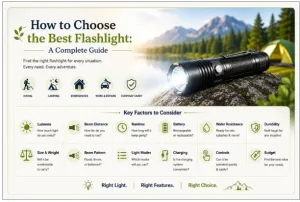
It might seem easy to buy a flashlight, but the minute you start shopping for them, you’re hit with specs like lumens, beam distance, runtime, water rating, beam type, battery and charging system, as well as physical dimensions. The brightest or the most expensive isn’t always the right light. It’s a light that perfectly matches your needs regarding its brightness, runtime, portability, durability and features.
In this blog, we discuss these flashlight specs, as well as provide advice to help you decide which are the most important based on the flashlight’s ultimate intended use (every-day-carry, camping, hiking, outdoor, tactical and emergency situations). If you’re comparing options, Premium flashlight brand Olight offers a range of models designed around different needs, making it useful to consider how features such as brightness, runtime, portability and durability vary between flashlights
Best Flashlight Features at a Glance
| Feature | What to Consider |
| Lumens | How much total light output is needed? |
| Beam distance | How far do you need to see? |
| Beam pattern | Flood, throw, or balanced? |
| Runtime | How long between charges, and at which setting? |
| Battery | Rechargeable or replaceable? |
| Size and weight | Will it be comfortable to carry? |
| Water resistance | What weather or water exposure will it face? |
| Durability | How rugged does it need to be? |
| Light modes | Which modes will actually be used? |
| Charging | Is the charging system convenient? |
| Controls | Can it be operated quickly and easily? |
What Should You Consider When Choosing a Flashlight?
Choosing the right flashlight depends on more than just how bright it is. Before buying, consider factors such as brightness, beam distance, runtime, battery type, size, durability, water resistance, charging options, beam pattern, and available light modes. If you’re still wondering what a flashlight is and how its basic components work, understanding the fundamentals can make these specifications easier to compare.
Your intended use also matters. A compact flashlight for everyday carry may have very different requirements from one designed for camping, hiking, automotive work, emergencies, or demanding outdoor activities.
The following factors will help you compare different flashlights and choose one that fits your specific needs.
1. Start With How You Plan to Use It
Before digging through specs, consider where and how you’ll use your flashlight. This is the deciding factor on what’s important. A compact, light EDC light should be easy to slip in your pocket.
A camping and hiking light will balance output, battery life, durability and water resistance.
Exploring the great outdoors requires long throws (beam distance) and good battery life. Home-emergency lighting requires a sturdy light you can quickly activate when the power is out. Automotive work needs either a compact light or an angled-body light for free hands. Professional use may require exceptional durability, outputs, reliable operation and extended range.
The companies build different lights to meet these varying needs.
2. Understand Lumens
Lumens measure the total amount of visible light a flashlight produces. A higher lumen rating generally means more light output, but more lumens do not automatically make a better flashlight.
Output requirements vary by task:
- Low output: reading, close-up tasks and finding items indoors.
- Moderate output: walking, home use and general EDC.
- High output: outdoor activities and larger areas.
- Very high output: searching, long-distance illumination and specialized applications.
Very high output is unnecessary for tasks such as reading or moving around a home. Lumens also indicate only total output, not how that light is delivered, which depends on the beam pattern.
3. Beam Distance and Beam Pattern
Two flashlights with the same lumen rating can perform very differently because of their beam. Beam distance indicates approximately how far a flashlight can illuminate according to its tested specification, and is usually given in meters.
A flood beam spreads light across a wider area and is suited to walking, working nearby, camping and general indoor visibility. A throw beam concentrates light farther into the distance and is suited to searching, open areas and long-distance visibility. Some flashlights are designed to balance both, and some offer an adjustable beam.
For indoor use, a long throw is usually unnecessary. For hiking, camping and searching, a longer beam distance can be valuable. When comparing models, consider lumens, beam pattern and beam distance together rather than lumens alone.
4. Consider Runtime
Runtime refers to how long a flashlight can operate under specified conditions and settings. Output and runtime are related: a flashlight may provide high output for a short period and a much longer runtime at lower brightness levels.
When assessing runtime, consider how long the flashlight will typically be used at a time, whether charging will be available, and whether it is needed for emergencies. Runtime figures should always be checked against the brightness setting they refer to, since a maximum runtime usually applies to a low setting rather than full output.
5. Rechargeable vs. Replaceable Batteries
Battery type does come into play, affecting charging and overall cost to operate. Flashlights that are rechargeable (commonly lithium ion) mean you can charge your light instead of buying more disposable batteries for convenience when you use your flashlight often and carry a flashlight every day. The latest Olight can be charged by USB-C, magnetic, or both. Newer model Olight features a combination of magnetic charge capability & USB-C.
Rechargeable battery flashlights will come in handy with no power source (or when you prefer spare batteries) or the ability to replace the cell will not be lost. This makes it a good choice for emergencies. Neither light technology is “superior,” depending on your personal situation.
6. Size and Weight
A flashlight with strong specifications can still be impractical if it is too large or heavy for its intended use. For everyday carry, consider overall length, diameter, weight, the pocket clip and grip. For a camping or emergency kit, size is usually less important than battery capacity and performance. The aim is sufficient performance without unnecessary bulk.
7. Water Resistance
Water-resistance matters when your light will likely get wet during outdoor use. The two most common flashlight ratings will be IPX4, IPX7, or IPX8, and the level of protection varies greatly depending on rating. Just because the flashlight looks like it may be protected it does not necessarily mean it will take much abuse.
Be sure to view the specification and confirm the flashlight’s true IP rating.
IPX4 simply means splashes; IPX7 is submersion for some time and usually shallower submersion, IPX8 is longer or greater depths of submersion. As an example, flashlight models from Olight range all the way up from IPX4 on a basic model, all the way up to IPX8 on higher end, tactical models for specific uses. If your light will be in rain, or is going to be used where wet, snow, crossing water, or wet work environments are involved, ensure you view the manufacturer’s claim in the specifications.
8. Durability and Construction
A flashlight intended for regular or demanding use should be able to withstand normal handling. Relevant factors include body material, impact resistance, water resistance, grip design, switch durability and lens protection.
Many quality flashlights use aluminum construction to balance strength and weight. Olight’s Warrior series, for example, uses aluminum-alloy bodies and includes IPX8-rated models designed for demanding applications. A flashlight used only occasionally indoors does not require the same level of ruggedness as one used regularly outdoors.
9. Light Modes and Controls
Multiple modes can make a flashlight more versatile. Depending on the model, available modes may include moonlight, low, medium, high, turbo, strobe, red light and UV light.
More modes are not necessarily an advantage if they are difficult to access. Simple, intuitive controls are often more useful than a long list of modes that are rarely used. Some models use multiple switches or dedicated controls to make specific output levels easier to reach. When comparing flashlights, consider which modes will actually be used and how quickly they can be selected.
10. Charging Method
If you’re looking at a rechargeable flashlight, the charging method is an option worth considering. Most people have access to a USB-C cable for their mobile devices, so charging a flashlight with USB-C offers a lot of flexibility. If your flashlight can also be charged using magnetism, such as the Olight ArkPro, that’s another benefit as there are no open port caps to get in the way of your work. Where will the flashlight most commonly be charged – at home, inside your car, workplace, around the campsite, or with your power bank?
11. EDC, Tactical or Outdoor Flashlight?
Here’s a general rundown of the main groups, keeping in mind they can all blur together to some degree.
EDC (EveryDay Carry) – Suitable for general day-to-day tasks, EDC flashlights focus on small, lightweight size, convenience of carrying, usability and often simpler recharging options.
Tactical – Primarily geared for stressful situations; often high-output, durable, good long-range performance, hard use controls, and instant access to modes.
Outdoor – Attempts to blend overall brightness with good runtime, solid build quality, weather-resistance and moderate size/weight.
There is significant overlap between these categories. A compact tactical flashlight may also work well for everyday carry, and an outdoor flashlight can be suitable for everyday use.
12. Do Not Choose Based on Lumens Alone
This is arguably the most significant consideration when choosing a flashlight. If you imagine two flashlights: with a greater max lumens; but only a short runtime, the beam size is narrower and the body size bigger in comparison to that of a greater runtime; but a more equal beam; a reduced max lumens and even smaller body size. For carrying on person the latter might be more preferable.
Comparison should also be made between lumen amount, lumen distance, runtime, body size, the durability, its battery type, features etc. Rather than over a solitary spec value
Flashlight Buying Checklist
Before purchasing, consider the following questions:
- Purpose: what will the flashlight primarily be used for?
- Brightness: how much light is actually needed?
- Beam: flood, throw, or both?
- Runtime: how long should it operate between charges?
- Battery: rechargeable or replaceable?
- Size: will it be carried in a pocket, backpack, vehicle or emergency kit?
- Durability: will it encounter rain, drops, dust or demanding conditions?
- Controls: can the required brightness level be accessed easily?
- Charging: is the charging method convenient?
- Budget: which features are genuinely worth paying for?
Final Thoughts
When deciding on which is the “best” flashlight; that is not to say highest lumen value on the flashlight. There is a “best” flashlight for every application and the purpose determines the quality of features.
If it is going to be an EDC the primary concerns should be compact size, portability and ease of charging; in terms of camping and hiking durability, run time and water-resistance become the highest priority to a durable, efficient beam pattern; and for hard outdoor or tactical applications throw or output of a light with rugged build and usable controls.